

Tank Specialties of California and
Advanced Emission
(559) 579-1450
(559) 579-1450
sales@tanksofca.com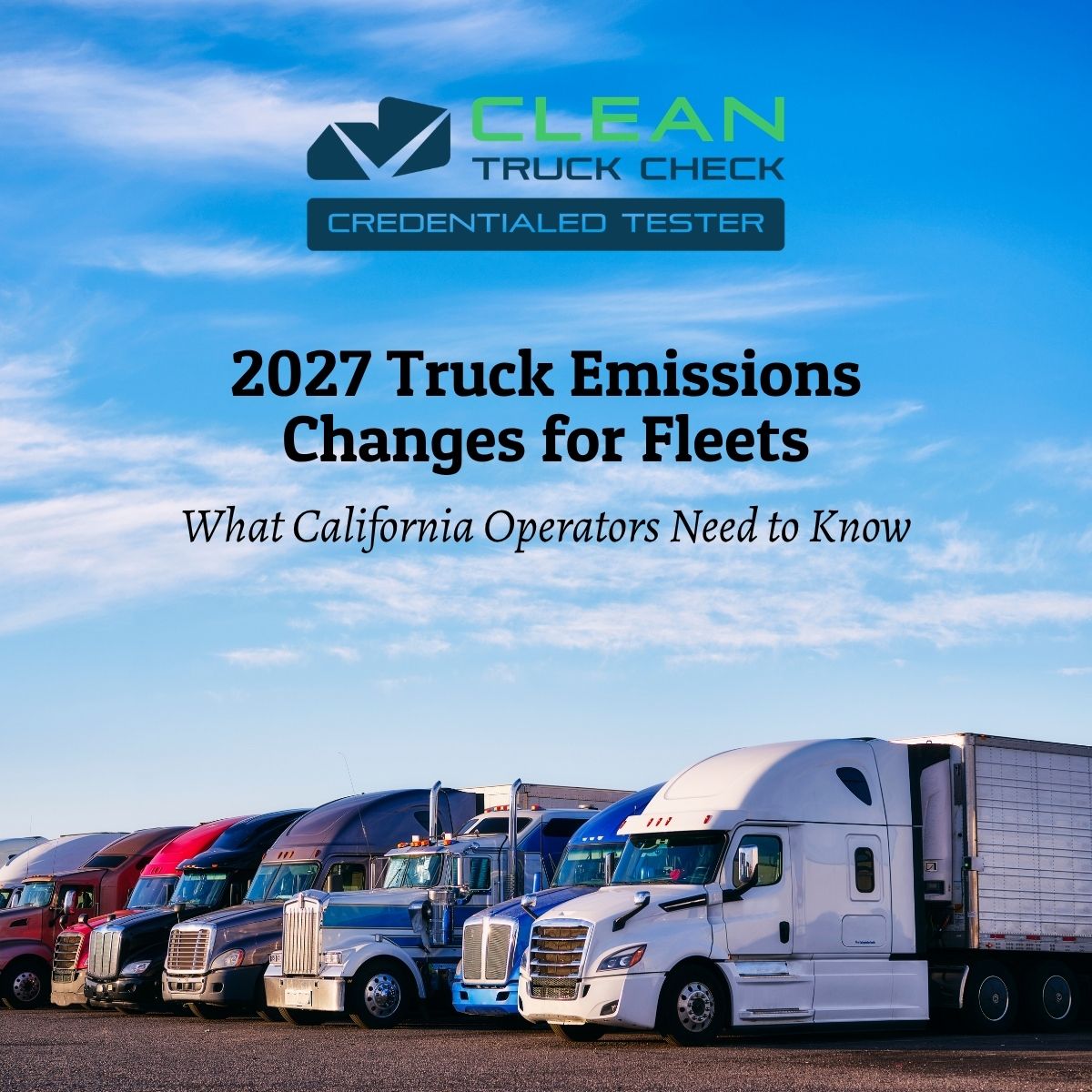
If you manage a diesel fleet in California, you have probably heard conflicting stories about what is happening with truck emissions requirements in 2027.
Some federal emissions requirements have changed. Others remain in place. Meanwhile, California fleets face another significant change in 2027 that affects many of the trucks they already operate. More frequent Clean Truck Check emissions testing is coming.
So, what is actually changing, and what should fleets be doing now?
The answer starts with separating several different regulations that are often discussed as though they are one and the same.
Much of the confusion surrounding 2027 comes from several regulatory developments happening at roughly the same time.
At the federal level, EPA's heavy-duty engine and vehicle emissions standards adopted in 2022 establish more stringent nitrogen oxide (NOx) requirements beginning with model year 2027.
Those requirements have not simply disappeared.
However, another set of federal requirements has changed. In February 2026, EPA finalized the rescission of the 2009 Greenhouse Gas Endangerment Finding and repealed subsequent greenhouse gas standards for highway vehicles and engines, including heavy-duty vehicles.
EPA has also proposed additional amendments to portions of the MY2027-and-later heavy-duty engine program. The proposed changes address areas including useful-life and warranty requirements, compliance provisions, and DEF/SCR inducement requirements.
The result is a regulatory environment that can be difficult for fleet operators to follow.
These different federal requirements must be distinguished from one another, since a change to one does not necessarily mean the others have changed as well. A repealed greenhouse gas standard, for example, does not affect the NOx requirements taking effect with model year 2027.
Fleets must consider which changes affect the trucks they plan to buy and which affect the trucks they operate.
Much of the national conversation about 2027 has focused on new trucks.
Engine manufacturers have been preparing new and revised engine and aftertreatment platforms for MY2027 requirements. That has led to questions about vehicle pricing, equipment availability, maintenance requirements, and whether fleets should purchase equipment before or after the transition.
Those are legitimate planning considerations.
But for California operators, focusing exclusively on the next truck purchase misses another important 2027 development.
The trucks already in your fleet may face a significant compliance change as well.
California's Clean Truck Check program requires emissions compliance testing for applicable heavy-duty vehicles operating in the state.
Currently, almost all vehicles subject to the program require semi-annual testing.
Beginning October 1, 2027, OBD-equipped vehicles subject to the increased testing requirement will need Clean Truck Check emissions compliance testing four times per year.
Qualifying agricultural vehicles and California-registered non-commercial motorhomes are exceptions and will remain on an annual testing schedule.
For diesel vehicles, Clean Truck Check generally considers 2013-and-newer diesel engines OBD-equipped. These vehicles undergo an OBD scan using a CARB-certified testing device.
Older diesel vehicles that are not OBD-equipped generally require a smoke opacity test and visual inspection of the vehicle's emissions-control equipment.
Because requirements vary, fleet operators should always check the individual testing deadlines shown for each vehicle in their Clean Truck Check-Vehicle Inspection System (CTC-VIS) account.
More frequent testing makes compliance scheduling increasingly important.
CARB allows a passing Clean Truck Check test to be submitted as early as 90 days before a vehicle's compliance deadline. That provides an important planning window.
Testing early can also provide time to address a problem if a vehicle does not pass.
If a vehicle fails its emissions compliance test, the necessary repairs must be completed, and the vehicle must be retested and pass before its compliance deadline.
OBD-equipped vehicles can also receive results such as "Not Ready" that do not satisfy the compliance requirement and require additional action before retesting.
For fleets managing multiple vehicles, waiting until the last minute can turn a compliance issue into an operational one.
The move to four Clean Truck Check tests per year doesn't have to mean four isolated compliance appointments.
Instead, it creates an opportunity for fleets to take a more coordinated approach to emissions compliance and routine diesel service.
When other maintenance is due, a scheduled Clean Truck Check visit may also be an opportunity to address services such as:
Maintenance needs vary by vehicle, mileage, engine hours, duty cycle, and manufacturer recommendations. By coordinating services that are already due with a scheduled Clean Truck Check visit, fleets can make better use of planned service time and reduce unnecessary trips to the shop.
That becomes increasingly valuable as fleets balance compliance requirements against the everyday need to keep trucks available and productive.
A DPF that becomes overloaded can contribute to frequent regeneration cycles, reduced performance, and warning lights. Depending on the filter's condition, professional cleaning may restore its function and avoid premature replacement.
Staying ahead of DPF and emissions-system maintenance can help fleets keep trucks performing properly and address developing issues before they lead to more costly repairs or downtime.
Clean Truck Check testing adds another regular compliance touchpoint. If testing identifies an issue, having diagnostics, maintenance and repair capabilities available through the same service provider can simplify the process of getting the vehicle repaired, retested and back on the road.
The uncertainty surrounding 2027 has understandably caused fleets to think about replacement cycles, new-engine technology and equipment costs.
Those decisions matter.
But maintaining the trucks you already own deserves a place in the 2027 strategy too.
For some fleets, the right decision may be to replace equipment. Others may benefit from maintaining existing vehicles longer. Off-road equipment can present another set of considerations, including whether an appropriate emissions retrofit is available.
There isn't one answer for every fleet.
What does make sense is to begin planning before regulatory deadlines force the decision.
Review the equipment you operate today. Understand which vehicles will be subject to increased Clean Truck Check testing. Stay ahead of maintenance issues. Evaluate repair or retrofit options where appropriate. Consider how required testing can fit into a broader preventive-maintenance schedule.
More compliance requirements shouldn't have to mean more vendors and more service stops.
Advanced Emission and Tank Specialties bring emissions compliance, testing, and fleet service capabilities together in one place.
Services include:
As California moves toward more frequent Clean Truck Check testing, fleets have an opportunity to make those required visits work harder by coordinating testing with maintenance and repair needs whenever practical.
The biggest mistake fleets can make is treating "2027 emissions changes" as one regulation with one deadline. The federal standards affecting new heavy-duty engines, evolving EPA requirements, and California's Clean Truck Check program are separate issues that can affect different parts of your fleet strategy.
One change is particularly clear for California operators. Beginning October 1, 2027, applicable OBD-equipped vehicles will require Clean Truck Check emissions compliance testing four times per year.
That makes now a good time to review your fleet, understand your testing obligations, and think about how emissions compliance can fit into a more coordinated maintenance strategy.
Advanced Emission and Tank Specialties can help you plan with testing, diagnostics, DPF service, maintenance, repairs, and compliance support under one roof.
Questions about your fleet's emissions compliance or service needs?
Call (559) 579-1450 to talk with our team.